Plum News & Events
Award-Winning

As soon as people find out that part of my job is to produce and stage large business conferences and corporate meetings across the country and around the world, they usually ask the same question: what is your favorite city or event venue?
The honest answer is that it depends. A business conference is never only a ballroom and a projector. You’re thinking about staging, lighting, sound, scripting, room flow, guest experience, and the way your message lands once the room is full.
Before you fall in love with a destination, start with the venue itself. The right room gives you control. It gives your production team options. It makes the event feel polished because the infrastructure supports the plan.
If you’re choosing a venue for a conference or corporate meeting, these are the first five things worth checking:
After that, look at the full attendee experience: travel access, hotel rooms, food, and what people can do when they’re off the clock. Those details matter too. But the room comes first, because that’s where your message either works or fights the space.
With that in mind, here are five locations that stood out to me for very different reasons.
Las Vegas is built for putting on a show. Hotels have large ballrooms, many ceilings already include rigging points, and attendees have no shortage of things to do once the sessions end. For the right conference, that kind of infrastructure changes the conversation fast.
Cost can be a factor, especially in union venues. Traffic can be another. We often bring in trucks full of staging and production equipment, and delays during load-in cut into rehearsal time. That matters because technical rehearsal is where problems get caught before your audience sees them: a microphone with static, a video that doesn’t play, a lighting cue that misses its mark.
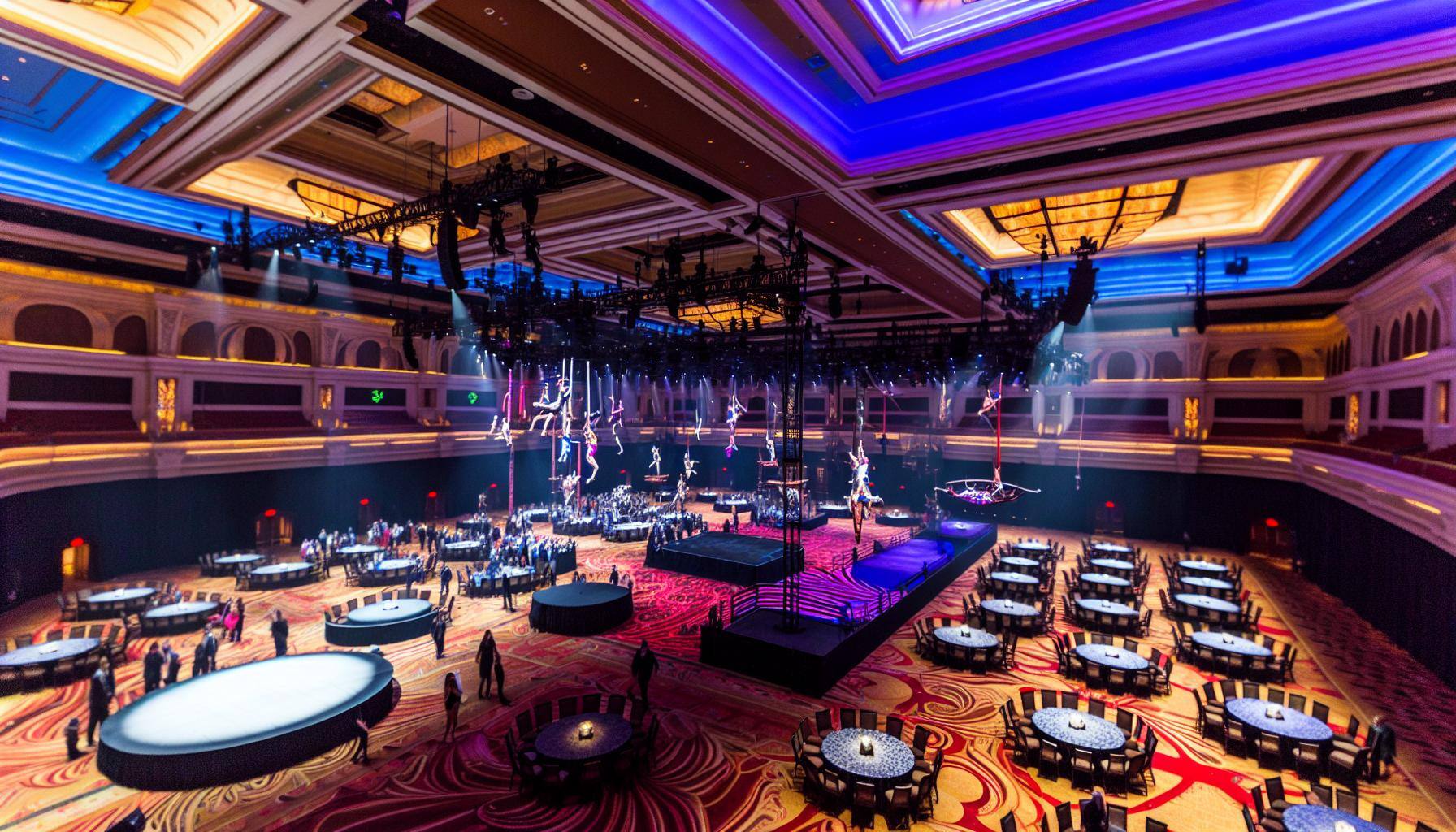
I recently produced and directed an event in the Chelsea Ballroom at The Cosmopolitan. We had more than 18,000 square feet of space and built a program inspired by Cirque du Soleil, with acrobats, balancing acts, and custom staging woven into the corporate messaging. Las Vegas was the right match for that kind of scale and ambition.
By day, Ellis Island is a national park open to the public. In the evening, it becomes one of the most memorable event settings you can imagine, with views of the Statue of Liberty and the Manhattan skyline framing the experience.
I produced a corporate event there several years ago, and people still mention it. Our theme, from set design to script, worked with the history of the location rather than around it. We hired actors to portray immigrants from the late 1800s, brought in a live band, and built an evening that felt connected to the place.
The challenge was access. We couldn’t leave equipment in place because the site needed to reopen to the public each morning. So we worked overnight in sections, blocking positions, testing systems, taking careful notes, and clearing gear before sunrise. It was demanding. It was worth it.
San Francisco offers a beautiful setting for a business event, with the added appeal of nearby wine country. It’s also where I saw one of the best transformations of raw space into business theater.
Our venue wasn’t a ballroom at all. It was a warehouse on a wharf near the Golden Gate Bridge. The location and scale were strong, but the room came with none of the usual ballroom support. That meant we had to bring in everything: staging, production gear, tables, chairs, linens, food, and entertainment.
By the time we were done, the warehouse had become a nightclub-style event space with a large projection surface and a lighting design that changed the entire feel of the room. That’s the value of a space with potential. If the bones are right, a skilled team can build the rest.
Tucson stands out for more than the weather. It also delivered the kind of venue partnership you remember. We were working at the JW Marriott Starr Pass Resort, and the account executive understood what the event needed and how to support the production team behind it.
That kind of support shows up in small moments that are not small at all: following specifications closely, solving problems quickly, and helping your team keep the schedule intact when something shifts late.
The event also included an off-site experience at Old Tucson, where attendees created their own short films. We wrote scripts, brought in extra crews, divided the group into teams, and edited footage overnight so their films could debut at the awards ceremony the next evening. The setting fit the concept, and the venue support helped the whole program work.
Marbella was a strong match for a global audience. Between the old town, the Strait of Gibraltar, and the Ronda Gorge, the location gave attendees a memorable sense of place outside the meeting itself.
At Hotel Gran Meliá Don Pepe, the production approach was more understated than some of the U.S. events I’ve worked on, but it fit the audience and setting well. We also hired local crew members to supplement our team, which added another layer of coordination.
International meetings bring their own production questions, including format compatibility and communication across languages. We tested our video playback equipment in advance so there were no surprises once we arrived. That preparation paid off, and the event ran smoothly.
Every one of these locations offered something different. What they shared was potential, support, and a setting that matched the event’s goals. That’s what you’re looking for. A venue should help your message land, give your production team room to work, and make the experience feel intentional from the moment people walk in.
If you’re weighing options for a conference or corporate meeting, start with the room. Ask hard questions early. Look for the venue that gives you clarity, control, and the right experience for your audience.